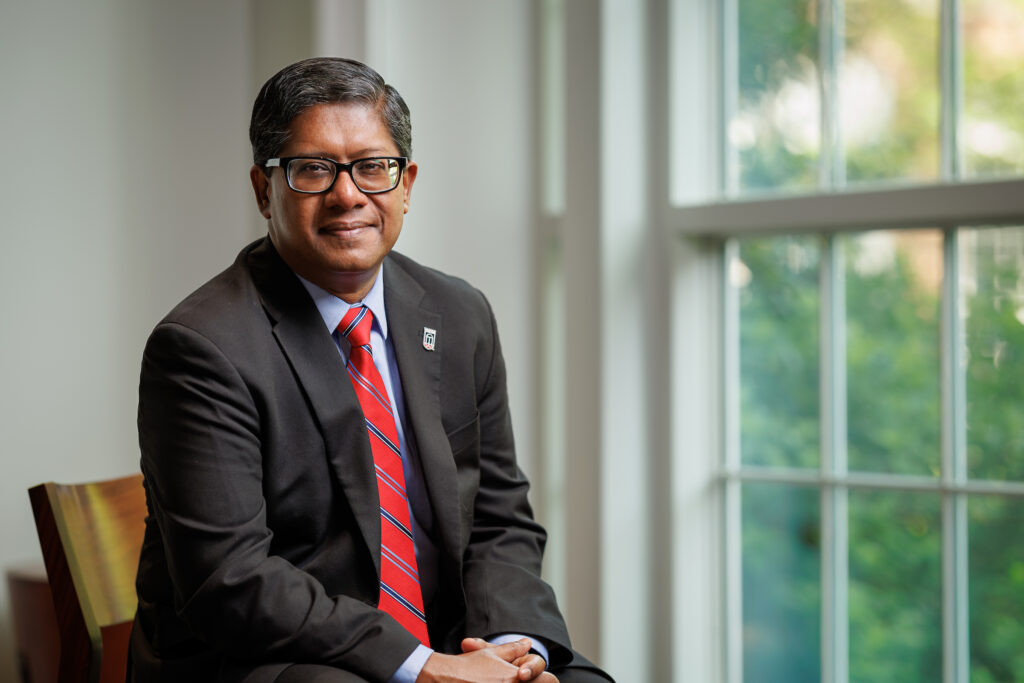
After serving as interim dean since last summer, Santanu Chatterjee was named the 13th dean of the Terry College of Business following a national search. He began his tenure April 1. A highly respected member of the Terry faculty since 2001, Dean Chatterjee holds the Dr. Harold A. Black Distinguished Professorship of Economics and previously served as director of the Full-Time MBA and Master of Science in Business Analytics programs, in addition to his role as associate dean for graduate programs.
Can you speak a little about your background and what brought you to UGA initially?
I grew up in Calcutta, India. I did my undergraduate education there and my master’s in economics in New Delhi. India was a very different country then. It was just opening up its economy to the rest of the world, and there weren’t a lot of opportunities.
There was a professor from the United States visiting my university. I explained to him that I wasn’t sure what I wanted to do. He asked me a few questions and said, “you’d do well with research, why don’t you think about the U.S. as a place to continue your education?” So, I went to the University of Washington for my PhD and ended up working with that same professor. When I finished my dissertation, he suggested I should be looking at academic jobs, because he thought I’d be successful there.
I had a couple of offers, including UGA. My professor pointed out that Georgia had this innovative program, the HOPE Scholarship, that could transform the university and the state. As we know, he was right. So, I chose to come to UGA, and it’s been a great 25 years here.
What kept you here?
The people. I came to Terry as an assistant professor in economics — it was a department that was supportive, and a college that was supportive as well. I saw the university quickly growing not only in numbers but also in quality. There was great leadership throughout.
I grew up in a city of almost 12 million people, and New Delhi was 18 to 20 million. When I moved to Seattle, it seemed quite small. Moving to Athens, as you can imagine, I wasn’t sure how it would work out. But we raised our kids here. My wife went to school here and worked for UGA before moving to the U.S. Department of Agriculture. My daughter’s a junior at UGA, earning her double major from Terry and Franklin. We’ve enjoyed living in Athens and being part of all the good things happening here and at UGA.
How would you describe your overall vision for the college?
I think we are well positioned to become the most student-centered, globally engaged and future-ready business school.
From a student perspective, we offer a mix of large and small classes, a variety of student organizations and a huge set of support systems. I want to make sure we are focused on maximizing the student experience inside and outside the classroom and preparing them to be leaders in their companies and communities — to be good, ethical decision-makers.
Georgia is a global state. Nineteen percent of its GDP comes from international trade. Atlanta is the home to many Fortune 500 companies. Savannah is one of the most important ports in the country. This is a state that is increasingly engaged with the global economy. As the flagship business school, it is incumbent on us to provide students with a global perspective — making sure every student has the option of a global experience, whether it’s a study abroad, an international internship or an exchange program.
And with new technologies evolving rapidly, we have to make sure students are ready to take on those challenges. First is the knowledge of our faculty, and in the middle is the technology and tools, whether it’s machine learning or coding and now artificial intelligence. And then the soft skills: leadership, teamwork, communication skills.
We need to have an integrated approach and make sure we are focused on each of these three pillars, so students are ready to take on any challenges or opportunities.
How do you plan to help Terry stay at the forefront of AI and ensure it’s being used ethically and strategically?
Any time you’re faced with something that is evolving quickly, you need to adapt, and to do that you need to have a plan. This doesn’t mean we stay fixated on it, but it gives us a road map. One of the first things I did as interim dean was commission two AI task forces — one led by faculty and the other by staff. I wanted to think holistically about the impact and the opportunity it creates for us, as well as academic and operational challenges.
The faculty task force has been looking at how to best integrate AI into our curriculum, applied learning environment, industry engagement, and research. And the staff task force has been looking at how to make sure our staff are up to date with the latest technologies and how they can use AI to be more productive, effective and efficient in their work.
We are working on a unified strategic plan for the college that will create a teaching and learning hub housed in the Ivester Institute for Business Analytics and Insights where we can provide our faculty, staff and students with the tools, training and information they need to be successful with AI. And of course, we are thinking carefully about the testing environment and academic honesty.
There are many pieces of the puzzle, but first we are going to put in place some of the more tangible pieces — for example, integrating AI into courses that all Terry students take. That way we can start working early on the culture of learning and making sure students understand this is just a tool, and knowledge, soft skills and leadership development are not substitutable by AI.
What are some of the other major challenges you see the college facing?
One of the things I think about a lot is the value of a college education in today’s economy. We have to make sure our curriculum is market-driven and market-responsive, that we are providing the best value to students in terms of preparing them for the future and maximizing the return on their investment. Terry has demonstrated success in that area. Our Full-Time MBA program comes out on top in a lot of those rankings. Our undergraduate programs are viewed as creating a lot of value relative to their cost. We want to maintain and build on that.
The second aspect is, given demographic changes in the U.S. and the fact that our population is aging, that will affect the demand for college education. We will not have as many young people coming out of high school, so there will be more competition for students. How do we best position ourselves to stay ahead in that competition? We need to remain selective, because we want to maintain quality. But we also want to make sure that if somebody has the talent and merit to come to Terry, we should be accessible. We should provide them with a high-quality experience, lower any financial barriers and prepare them for the future.
You mentioned the Full-Time MBA. You oversaw that program during a period of growth in rankings and reputation. What contributed to that?
A relentless focus on our people and our product. We tried to create an ecosystem which was about making sure we were listening to our students and our alumni — not only listening, but being responsive, making sure the curriculum stayed relevant. We made a big investment in experiential and industry-engaged learning that allowed our students to solve real-world challenges throughout their time in the program.
We built a bench of part-time instructors who are leaders in their companies, and we made sure we had the best faculty teaching in the program. We remained engaged with our alumni, who are champions for our program within their organizations. The model of the program, which kind of came organically, is to recruit the best students, give them the best experience and maximize their employment opportunities.
Speaking of people, how do you plan to continue to recruit and retain top faculty?
We have to keep capitalizing on our successes. Last year, our faculty had almost 90 publications in A-list journals. We have more than 35 faculty who are either editors or associate editors for top journals in their field. We spent about $22 million on research. We have tremendous momentum.
Our undergraduate programs are growing at more than 2% per year. When you have more than 10,000 students, that is a big number. And we had a 14% increase in graduate enrollment. We need to make sure we have a classroom environment where we are connecting with students, and we need to identify areas that make us future ready. We’ve made investments in artificial intelligence, health care, real estate, risk and resiliency. And we have a great group of faculty doing great work.
We have to build on that momentum to continue attracting high-quality scholars. Part of that is continuing to celebrate the tremendous success of our faculty and remain competitive in retaining and recruiting top talent. Another key aspect is making sure our academic departments are self-sufficient. Endowing our departments was a key priority for Provost Ayers when he was dean, and I intend to build on that.

Where else do you see potential for growth? We talked about challenges. What are opportunities to be excited about?
One of the things we’re working on is a supply chain major within the Management Department, which would be our first new undergraduate major in decades. Again, it leverages the reality that Georgia is one of the largest hubs for logistics and transportation. I think it is a no-brainer for us to make an investment in that area.
The global engagement aspect is a real opportunity for us. We have a large number of students traveling abroad, but there’s a lot of room to grow there. I hope Terry becomes truly global, where our students have those experiences, our faculty tap into international opportunities, and we establish our brand as a premier business school at a global scale.
Another area where we can grow quickly is online. Many Georgians are enrolled in online programs from outside the state. The last two programs we developed, the Online MBA (OMBA) and Master of Professional Accountancy, have seen surging enrollment. We’re launching the Master of Science in Business & Artificial Intelligence, which has strong initial demand. Online education is a great way for us to expand enrollment without putting pressure on our physical facilities. We can also leverage the strength of our faculty and potential of our Executive Education programs to build a lifelong learning environment for our alumni and corporate partners.
You’re alluding to space limitations. Are there plans for expansion?
We’re at a point where we are very quickly running short on space. As we think about enrollment growth, we also must think about the support structures that are needed for that growth — providing students, faculty and staff the resources to be successful so we preserve a high-quality learning environment. That will require us to think about expanding our facilities in a way that not only caters to current demand, but also future demand.
In your 25 years, what stands out most about how the college has grown?
You often hear two things about our grads: they’re extremely well rounded, and they can get into an organization, roll up their sleeves and get to work. And those two things, I think, really set a Terry graduate apart. I’m very proud of the partnerships we have built across campus over the past decade. We developed MBA pathways leveraging relationships with other schools and colleges such as engineering, medicine, pharmacy, public health, law and social work, among others. And that gave us a taste of how productive a collaborative working environment can be. That’s something I will continue to make a top priority, building partnerships and creating a collaborative interdisciplinary approach. Our Entrepreneurship Program, along with the Institute for Leadership Advancement and the Music Business Program, play an important role in building a more collaborative and interdisciplinary learning environment for the UGA community.
On a personal level, what does it mean to you to take on this responsibility?
This university has given me a lot. I built my entire career here. I started off as an assistant professor, worked my way through the life cycle of an academic, then was given the opportunity to get into administration as a program director, to step into an associate dean role, interim dean and now this. That is a testament to the institution — people who, as they build their careers here, end up in much different places than where they thought they would ever be.
This university and this college have given me so many opportunities. In this role, I have an opportunity to give back to our students, faculty and staff and work with them to help Terry take the next step. It’s very humbling and gratifying.
Anything else you’d like to touch on?
I don’t know if there’s any other institution where the alumni are so passionate about preparing the next generation of business leaders. That passion, that loyalty is, I think, unparalleled — whether it’s as simple as mentoring a student, coming in to talk to a class, serving on a panel, organizing a company visit or supporting us financially. If you look at our facilities, at all the things we’ve been able to do that elevated Terry to a new level, none of it could have been possible without our alumni. That’s one of the things I’m most excited about.
The financial support is critical, and we’ve been very fortunate. But one of the most undervalued commodities we have in our lives is time. And the fact that our alumni give that commodity so generously to us is eye-opening. It’s something that cannot be replicated anywhere else. And it’s one of the key factors in our success across the board.