
Sustainable business is more than making sure everyone has a recycling bin at their desk.
From responsible marketing to building the back end of the circular economy, Terry College students are building the skills they need to ‘do good, while doing well’ in tomorrow’s economy.
Colby Cannizzaro, a senior studying management information systems and pursuing a UGA Sustainability Certificate, found a place to apply his Terry College data analytics and project management skills when he started volunteering with the UGA Office of Sustainability.
Since his freshman year, he has served as the office’s chief cycling advocate, and as a student outreach intern. He’s working as the UGA Sustainability Office’s Post-Landfill Action Network Atlas Fellow and zero waste intern — leading plans to reduce waste at UGA and serving as a waste reduction consultant.
He’s passionate about trash and helping people make less of it.
Recently, his team worked with MARTA to conduct waste audits at its stations ahead of this summer’s World Cup.
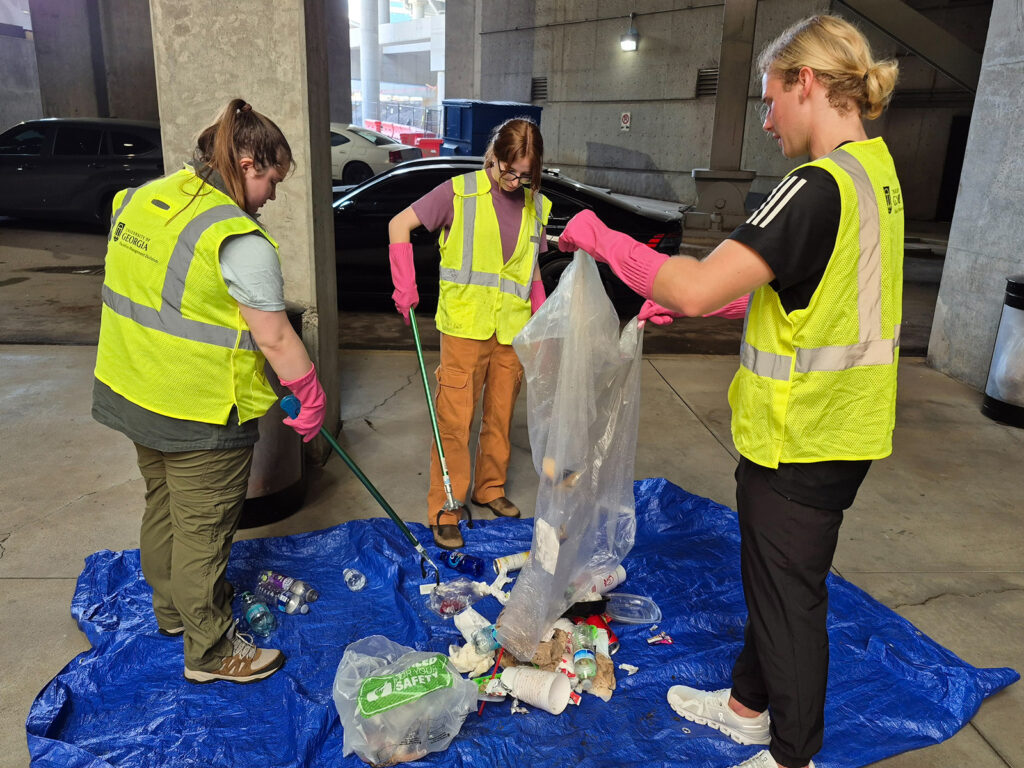
“Almost all of sustainability work starts with that first audit, right?” Cannizzaro said. “We have to go and get the data. So, we sorted through the trash, looked at the data, and asked, ‘Does MARTA even need recycling at these stations?’ The answer was, ‘Yes,’ because 40% of the trash we logged was recyclable.”
Cannizzaro helps manage data tracking waste reduction efforts on campus as well. Right now, his team is focused on increasing the number of compost bins on campus that feed into Athens-Clarke County’s industrial composting program.
He’s also helping to streamline the UGA surplus system, which offers used office equipment and furniture to other UGA offices. He imagines a system where getting a gently used office chair from across campus is as easy as ordering a new one from Amazon.
In each role Cannizzaro has had at the Office of Sustainability, none of the solutions matter if you don’t have buy-in from the community, he said.
“I don’t think I could have learned stakeholder engagement as well as I have here,” he said. “There’s no class that can teach people how to interact with a stakeholder and help them understand why something is important.”
Like Cannizzaro, Ruby Gagnon, a senior majoring in marketing and international business, has woven her passion for the circular economy into her work at Terry.
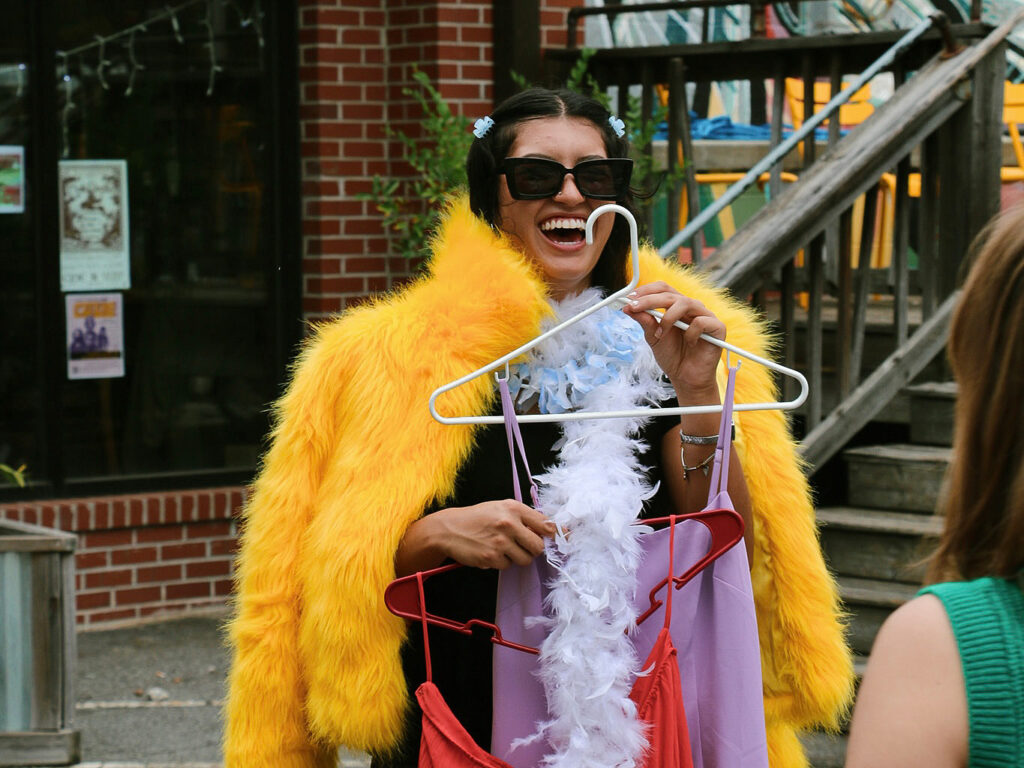
As co-president of UGA Fair Fashion — a UGA club educating students about the environmental and social costs of fast fashion — Gagnon curates clothing swap events around Athens and organizes sewing workshops.
“I would say the main purpose of fair fashion is to educate students on the impact that their buying choices have on the environment and on society at large,” Gagnon said. “We try to create spaces, both on and off campus, for students, faculty, staff and local community members to come in and swap clothes that they don’t wear anymore for something new so they can avoid buying new things all the time. The primary purpose is to promote circularity and to build a community.”
For Gagnon, who wants to eventually work in sustainability communication, working with Fair Fashion helped develop her communication and stakeholder management skills. Those skills have been key in her internship with the UN Global Compact Network USA and will be part of her full-time role when she joins UPS after graduation.
“In sustainability communication, you have to market concepts that are sometimes hard for people to understand or ideas that some audiences might resist,” Gagnon said. “Working with Fair Fashion has taught me how to better understand my audience and how to tweak some of the concepts we’re presenting so that people aren’t as afraid of sustainability.”
While Gagnon and Cannizzaro found their niches across campus, Terry’s Sustainable Business Society offers students from various majors the opportunity to work as consultants for local businesses seeking to solve sustainability issues.
“Let’s say it’s for a restaurant,” explained Sustainable Business Society consulting co-chair Blake Jorgensen, a junior studying economics. “If, say, they’re using plastic straws and cups, the students will research sustainable alternatives and do a cost analysis of their options as part of a larger plan to reduce the restaurant’s waste. At the end of the semester, the teams put together a report for their client and gave a presentation for our club. It’s very hands-on.”
This year, teams of student consultants are working with Athens Running Co., a running outfitter, Classic City Cycling, a spin class studio, and Union Fare, a downtown bar that hosts multiple food trucks.
“The most unique aspect of Sustainable Business Society is that there is more of an active aspect to the club,” said Mahathi Bodhanapalli, a sophomore MIS student who led the Union Faire consulting project. “It’s given me the most hands-on experience where I can actually see how what I’m doing is making an impact.”