
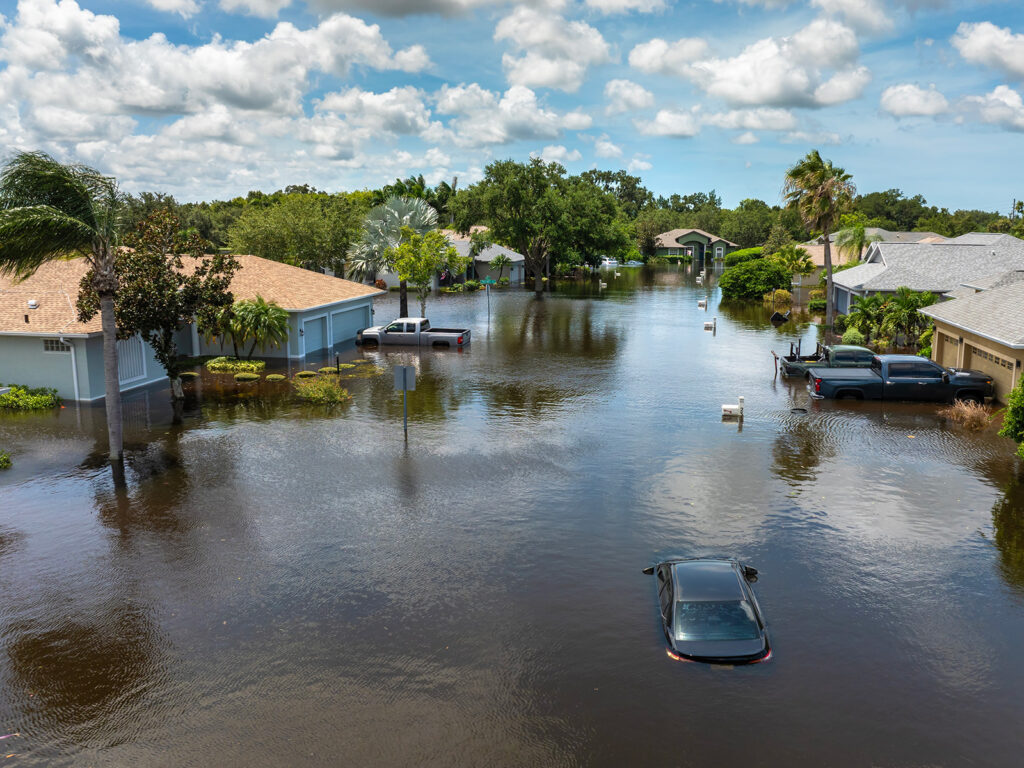
This year’s Atlantic Hurricane season has — thankfully — been abnormally quiet.
But even without a single hurricane forming in the Atlantic, homeowners in the Southeast homeowners still face the weight of hurricane damage when making a homeowners insurance payment.
Tobias Huber, an assistant professor of Risk Management and Insurance at the University of Georgia Terry College of Business, studies catastrophic risk and insurance markets.
In a recent study featured by the Brookings Institution, Huber and his coauthors examined the rise in hurricane damage and property insurance rates. They found that modeled expected hurricane losses in Florida increased by 50% since 2006, but hurricane insurance premiums jumped by more than 200%.
It makes sense that premiums will go up when losses go up. But why are premiums so much higher than the losses insurers are expected to pay?
Premiums aren’t supposed to match the losses in any given year. Insurance spreads risk across many policyholders and across time. Even in a year without a hurricane, insurers have to be prepared for the possibility of a catastrophic event.
Expected losses are also only one part of the premium. For example, insurers have operating expenses and need enough capital to pay claims after an extreme event. Hurricanes are particularly difficult because one storm can damage hundreds of thousands of homes at once.
So, some difference between premiums and expected losses is normal. What surprised me was how large that difference is: about $4 in hurricane premiums for each $1 of modeled expected hurricane loss. Our results suggest that much of that difference reflects the high cost of preparing for rare, catastrophic losses.
How can you tell that premiums are higher than hurricane risk alone would explain? What data sets did you look at?
Florida gives us unusually detailed data. We combine catastrophe models with insurance companies’ rate filings. Catastrophe models estimate hurricane risk by location. Rate filings allow us to separate the hurricane portion of homeowners premiums from other insurance costs. These data hadn’t been put together this way before. We hand-collected nearly two decades of insurer rate filings and matched them to the catastrophe model estimates.
These are the kinds of models that insurers use to set rates. In Florida, hurricane loss estimates used in rate filings must come from models accepted by a state commission that evaluates their reliability.
Together, the data let us compare changes in modeled hurricane risk with changes in what insurers charge.
You point to reinsurance — the insurance that insurance companies buy to protect themselves from bankruptcy — as an important driver of rising home premiums. Why do companies use reinsurance? Why has reinsurance become such a large portion of our insurance premiums?
A hurricane can create enormous losses for many policyholders at the same time. Insurers use reinsurance to transfer some of that catastrophic risk to other companies and global capital markets.
But that protection is not cheap. Reinsurers need capital for the possibility of an extreme event, and investors need to be compensated for putting that capital at risk. Reinsurance prices rose sharply after the severe hurricane seasons beginning in 2017, and Florida premiums rose along with them. More generally, we find that Florida hurricane premiums move closely with conditions in global reinsurance markets. When reinsurance becomes more expensive, homeowners ultimately feel some of that increase.
Major national insurers such as State Farm and Allstate have limited their exposure in Florida’s highest-risk areas, leaving local Florida-based companies to take over. How does that affect the market?
Florida’s market has three main types of insurers: large national insurers, Florida-focused companies, and Citizens, the state’s insurer of last resort. We find that large national insurers are concentrated in Florida’s lower-risk areas, while Florida-focused companies play a larger role in medium- and high-risk areas.
A national insurer operating across many states can spread Florida hurricane risk across a much larger portfolio. In contrast, a Florida-focused insurer has much more of its business exposed to the same risk and therefore tends to rely more on reinsurance.
That difference shows up in their costs. Costs above expected losses are typically larger for Florida-focused insurers, and they are more volatile as reinsurance prices rise and fall.
Everyone wants insurance they can afford. Why can’t we cap the amount insurers can charge?
A price cap changes what an insurer can charge, but it doesn’t change the underlying hurricane risk. If insurers cannot charge enough to cover the cost of providing coverage, they may write fewer policies or leave the market.
Risk-based prices also give homeowners incentives to make their properties safer. I think it is important to distinguish between making insurance more affordable and artificially suppressing the price of risk.
You focus on Florida in your study, but do your findings also apply to other states or to risks like wildfire and hail?
We should be careful about generalizing the roughly four-to-one relationship we find in Florida to other places or other types of disasters.
Hurricanes are especially difficult to insure because a single storm can cause enormous losses across many properties at the same time. That kind of rare, widespread loss is expensive to finance. We would expect the difference between premiums and expected losses to often be smaller for risks that are easier to diversify.
But this may become increasingly relevant beyond hurricanes. Wildfires, hail and tornadoes can also generate large, simultaneous losses, so the cost of preparing for catastrophic events could become a more important part of insurance premiums for those hazards as well.
What could policymakers do to make insurance more affordable?
I think about this in two ways. First, we can reduce the risk itself through stronger building codes and by making homes more resilient. That’s easier for new construction than for the many homes already standing.
Second, we can look at what it costs to finance the risk that remains. That could mean bringing insurers that operate across many states back into Florida’s higher-risk areas or making catastrophe reinsurance more affordable. Florida already has a public reinsurance program, but insurers still rely on private reinsurance for very large losses.
I became interested in this question while I was at UNSW Sydney, where my colleagues and I met with the Australian Reinsurance Pool Corporation. Australia’s government-backed cyclone pool is an interesting example: early indications suggest premiums have fallen in high-risk areas since it was introduced.
I’m not saying Florida should copy Australia. But I do think it’s worth asking whether we can lower the cost of financing catastrophic risk while preserving homeowners’ incentives to protect their homes.