
India’s tech-fueled 400% economic growth over the past 25 years is nothing short of phenomenal, but the real story is one of contrasts.
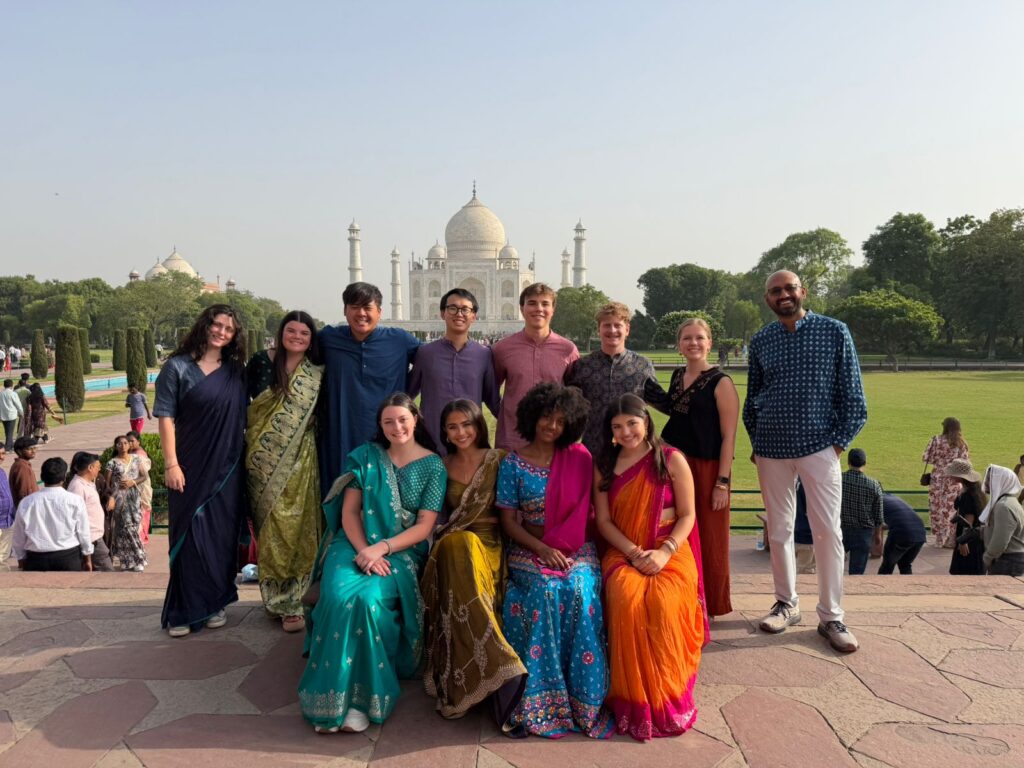
The Terry College of Business students who toured the country as part of the inaugural Maymester in India found amazing modern technology set against a backdrop of ancient architecture, with the weight of respected tradition operating alongside the drive to innovate.
“It’s an insane, insane growth rate,” said Mattie Comte, a senior studying finance and management information systems, who was one of 10 students who helped make the trip a success. “I think right now they’re operating at 6% GDP growth per year and their target is 8. That’s crazy to have an 8% target. Whenever we were in the spaces with these businesses, you could tell that they were putting all their focus in and on growth. But it’s different. The main thing I took away was that just because it isn’t the way that we do things doesn’t mean it’s wrong.”
During the two-week course, students traveled with MIS senior lecturer Nikhil Srinivasan from India’s financial and trading hub, Mumbai, to the technology capital, Hyderabad, before ending in the political capital, Delhi.
“Across 2 weeks, 3 cities, 9 company visits, students had business and cultural experiences in a rapidly developing economy one reads about in new articles and videos,” Srinivasan said. “They learned how India’s traditional business practices are transforming and leading the world in areas of unified identity verification, payments infrastructure and more. They were immersed in unfamiliar and novel cultural environment and emerged with an understanding and experience on how to navigate such new terrain.”
In Mumbai, students toured millennia-old cultural sites and learned about India’s economic history and growth. They also visited the center of operations for Mumbai’s Dabbawala network, an incredibly coordinated team of 1,500 delivery workers who transport 200,000 warm lunches from office workers’ home kitchens to their offices every day.
Their offline logistics system is based on color and alphanumeric coding and boasts a near-perfect accuracy rate, said Alex Wiegand, a finance major.
Equally amazing, he said, was the entire nation runs on a unified payment interface that has replaced cards and cash for most transactions, made possible by ultra-cheap and plentiful cell phone data.
“They have a very extensive UPI (unified payment interface) that uses online biometrics that’s connected to everything,” Wiegand said. “It helps keep track of how many people are in a certain area, but it’s also how you pay for things. I don’t think we need that level of scrutiny, but I thought it was very interesting how I could go to any food cart or any vendor on the street and pay using my phone.”
Wiegand and his fellow students visited tech hubs such as Microsoft’s Hyderabad Campus, venture investment group Dallas Venture Capital, and T-Hub, the world’s largest tech incubator.
Even in the tech capital, they saw the contrast between old and new in action, where formal age-based hierarchies still guided how employees interacted. This felt like a contrast to the more relaxed corporate cultures or young founder-centric culture prevalent in the U.S. tech sector, Wiegand added.
“One thing that I thought was pretty interesting, especially for a younger person to get used to, is how the traditional hierarchy affected whom people would address when they were answering questions from the group,” he said. “I vividly remember when we were at (circuit board manufacturer) Keerthi Industries, one of us would ask a question and rather than addressing the answer to the class, they would address the answer to one of our faculty members. It was the idea that important information needed to go to the people in charge first.”
For Comte, the biggest tension she felt was between an intense drive to build innovation and grow businesses and a cultural focus on mindfulness.
“One thing that really resonated with me was that even with the craziness going on, people still seemed to take time for themselves,” she said. “There’s a big emphasis on that. There’s so much going on everywhere, but the focus on mental health was still ingrained so deeply in the culture.”
Comte looks at the tension — between tradition and extreme modernity — as the key to what has made India successful, and it’s something she’ll carry with her into her career, she said.
“Everybody comes from different places, and I think it’s good to recognize that and see that people’s thought processes and strategies can be different,” Comte said. “I think that the numbers speak for themselves. When you have a 6% growth rate each year, something is really working.”