Artists, writers, and musicians worry about their livelihoods in a world of generative artificial intelligence. But artist rights advocates see AI as another front in the ongoing battle to protect their intellectual property.
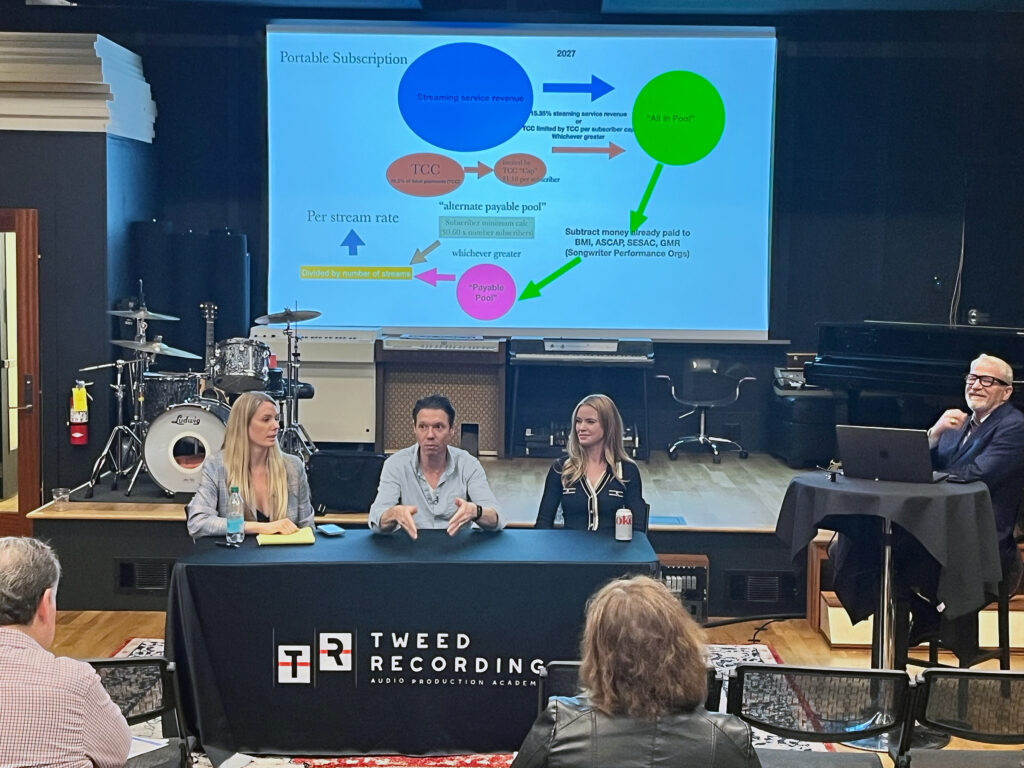
When the UGA Music Business Program hosted its fifth Artist Rights Symposium this October, musicians, intellectual property attorneys, managers, and policymakers gathered to discuss how to tackle the newest challenge to their ability to make a living from their craft.
“I’ve now watched several generations of technology companies and distribution platforms announce that artists’ rights are obsolete,” said David Lowery, a principal lecturer in the Music Business Program, to the crowd at the opening of the symposium. “Yet mysteriously, these companies keep building enormously valuable businesses on this supposedly obsolete property.”
Since 2018, the symposium — cohosted by the Artist Rights Institute — has become a place for people across the music and recording industry ecosystem to discuss the status of intellectual property in relation to new technologies — from file sharing, to streaming, to mass digitization and now generative AI.
Lowery, who has often worked with other independent songwriters to sue technology companies they feel are stealing their music, cast the discussions about protecting intellectual property from abuse by AI models as a continuation of the same struggle.
Panelists discussed different challenges they are facing.
Coweta County resident and advocate Ansley Brown, Georgia State Senator Sonya Halpern and the Human Artistry Campaign’s Moiya McTier spoke with attorney and Artist Rights Institute director Chris Castle about the pressure expanding AI data infrastructure places on rural communities and creative ecosystems.
Entertainment attorneys Jen Jacobsen, Chad Bell, Gwendolyn Seale and Tim Kappel discussed how their clients can protect their faces, voices and playing styles from being used and exploited by generative AI models.
Bell specifically discussed the class action lawsuit his firm recently filed against song-creation model Suno AI. The suit aims to keep Suno from creating music that uses artists’ voices or public personas to make songs that appear to be created by the artist.
Attorneys and advocates also discussed the Byzantine formula that determines how much artists are paid per online stream and how that system could be improved. Another panel discussed how industrial-scale ticket scalpers abuse the online secondary ticket market.
Many of these issues will need legislation and litigation to solve, Castle told the crowd, but that doesn’t mean it’s not worth pursuing.
“Everybody on these panels has been told at different times, ‘Oh, you’ll never win that argument,’” Castle said, describing the ongoing struggle to protect artists’ rights. “But artists’ rights advocacy is really an ‘any given Sunday’ type of situation. You go to court, and somebody’s going to win, and somebody’s not going to win. It’s a game of inches, and that’s what we are here to do.”