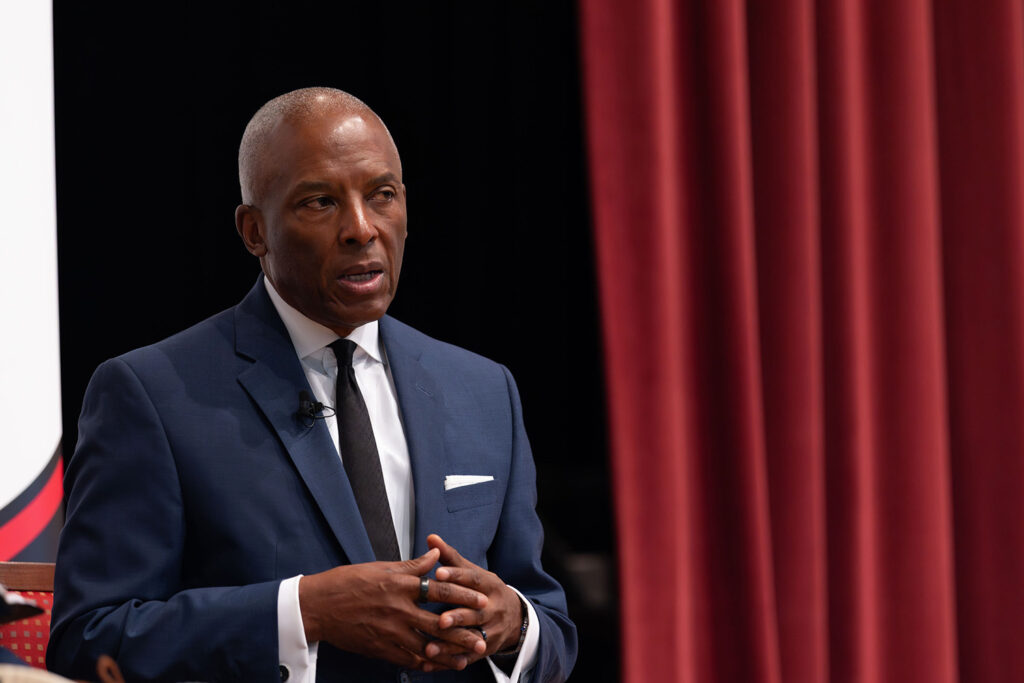
From student government meetings at Greenville High School in his Alabama hometown, to the halls of the U.S. Capitol, to a boardroom in downtown Atlanta, Southern Company CEO Chris Womack used public service as a compass to guide his career.
“Any institution — whether it’s a company, a university, whatever it may be — its members live and work in those communities where we operate,” Womack told University of Georgia students gathered at the UGA Chapel for the 2026 Mason Leadership Lecture, part of the Fall 2026 Signature Lecture Series, on Oct. 14.
“As a result, we have a requirement, a responsibility, a duty to make sure we’re making those communities better … I think we have an incredible responsibility to give back and try to find ways to make a difference. It is something that is deeply rooted in me.”
The Mason Public Leadership Lecture, part of the ILA Leadership Lecture Series, is hosted by the UGA Institute for Leadership Advancement. It features prominent business leaders who contributed to their communities or spent time in public service. A gift from Terry College of Business alumnus Keith Mason (BBA ’82, JD ’85) supports the lecture.
Womack, who grew up in a tight-knit community southwest of Montgomery, Ala., told students he was taught early on to get involved and give back to the community.
He watched his neighbors share the bounty from their gardens and successful fishing trips and come together whenever someone needed help.
As a college student at Western Michigan University, he saw that spirit on a larger scale when he interned with the Kalamazoo City Manager’s office — helping ensure parks stayed open and snow was plowed.
After graduation, he interned with Ralph Nader’s office and worked in Rep. Leon Panetta’s office. In the late 1970s and early 1980s in Washington, Womack saw legendary House Speaker Tip O’Neill guide Congress and work across the aisle with President Ronald Reagan’s White House to get things done.
“I really learned that if something wasn’t working, you can push to correct it. And if there is a gap, then something needed to be changed,” Womack said. “When you go through those kinds of experiences and see that you can make a difference — that you can change things, that you can correct things — it’s impactful. That has been an important part of my career and one of the things I get excited about.”
He loved Washington, D.C.’s fast-paced environment and that every day was different. But with a growing family, he and his wife decided to move back South so their children could be near their grandparents.
In Birmingham, he had two options: continue government service as chief of staff of the Birmingham mayor’s office, or step into a government relations role at Alabama Power.
He took the private-sector job to round out his résumé but found it more engaging than he imagined. The company gave him new problems to solve, and the skills he gained in Washington — building coalitions, getting up to speed quickly, communicating priorities, finding compromise — were key in this new role.
“The skills I had picked up in terms of being a quick study, being adaptable, being flexible and building and leading teams served me well,” Womack said. “As you lead teams, you learn very early on that you really can’t get anything done by yourself. … You need to build a team that is excited about working together and passionate about the work that you’re doing and the results that you can achieve. And that’s what I was able to do at an early age (in Washington and then at Alabama Power).”
As he rose through the ranks at Alabama Power and then Southern Company, Womack pinpointed team building and communication as key strengths. When recruited for a new role, he understood those strengths were being called upon.
In 2020, Womack became CEO of Georgia Power, and in 2023, president and CEO of Southern Company. He relies on those strengths as he guides Southern Company through a period of rapid growth.
“There are no easy answers in society today,” Womack said. “As we build our infrastructure all across our country — as we decide routes and paths to take — we’re always making sure that we’re choosing the best option for the community in terms of where there’s least impact on individuals and homes, making sure we’re finding that right balance to those infrastructure investments.
“There’s always going to be some pushback … We want to make sure we’re communicating, make sure we’re clear in terms of communicating why we’re doing what we’re doing, and what the benefits are.”
In addition to building trust as honest community stakeholders, Womack said private firms need to be more active in creating positive change in their communities.
“Everything is incredibly complex, and that’s what businesses do each day — we solve complex problems,” Womack said. “I think with some of the issues that we face today, business should take a bigger role.”
He pointed to the Atlanta anti-homelessness group Partners for Home, which brings together government, nonprofit, business and community stakeholders to reduce homelessness in Atlanta, as an example of what can happen when the business community steps up to help solve a societal problem.
Public service — the act of working to make things better for your community — doesn’t belong to people with a certain job title or work for a certain institution. It’s a responsibility that belongs to public officials, executives and community members because no one has the answer by themselves.
Ultimately, that’s the team that Womack’s been building from this childhood in Greenville until today.